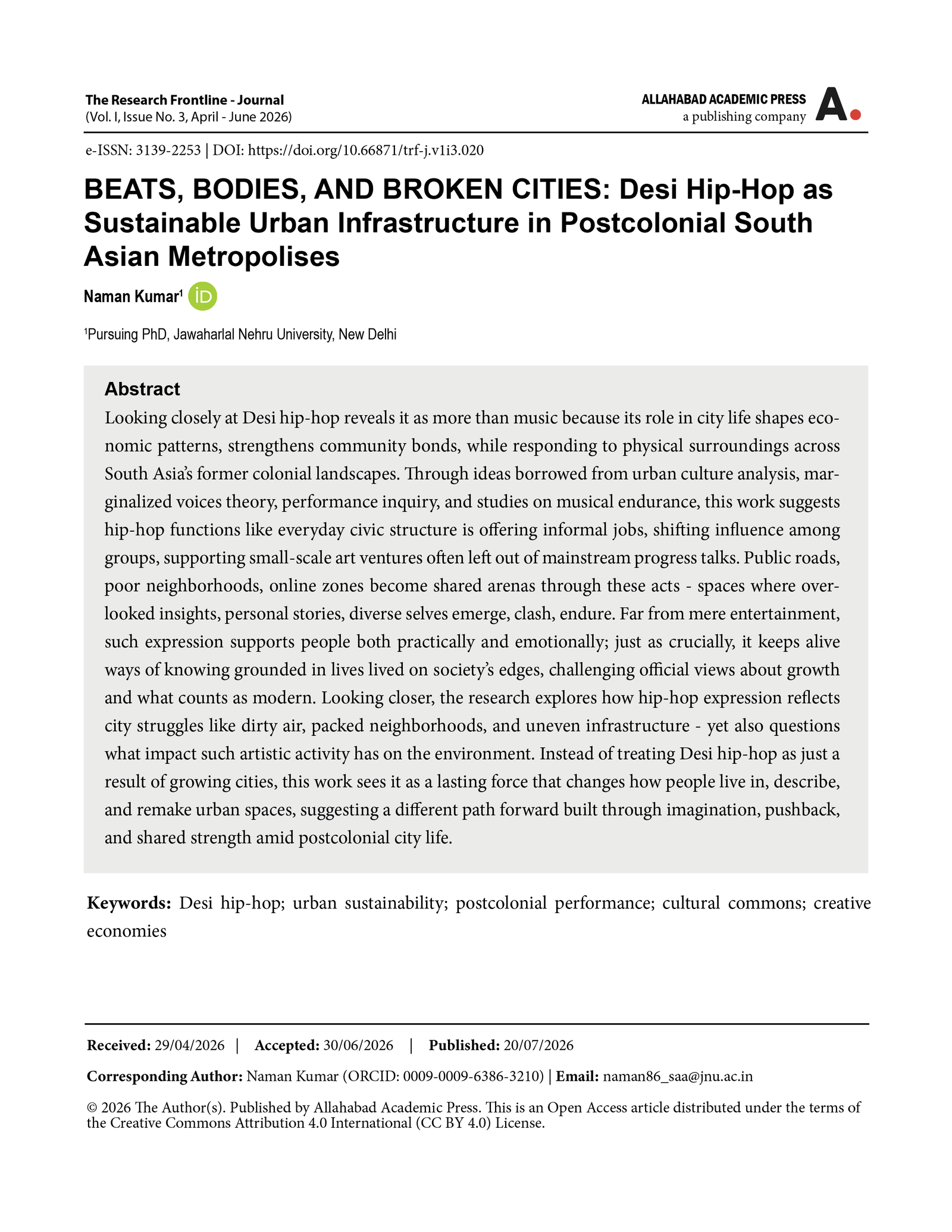
BEATS, BODIES, AND BROKEN CITIES: Desi Hip-Hop as Sustainable Urban Infrastructure in Postcolonial South Asian Metropolises
DOI:
https://doi.org/10.66871/trf-j.v1i3.020Keywords:
Desi hip-hop, urban sustainability, postcolonial performance, cultural commons, creative economiesAbstract
Looking closely at Desi hip-hop reveals it as more than music because its role in city life shapes economic patterns, strengthens community bonds while responding to physical surroundings across South Asia's former colonial landscapes. Through ideas borrowed from urban culture analysis, marginalized voices theory, performance inquiry, and studies on musical endurance, this work suggests hip-hop functions like everyday civic structure by offering informal jobs, shifting influence among groups, supporting small-scale art ventures often left out of mainstream progress talks. Public roads, poor neighborhoods, and online zones become shared arenas through these acts—spaces where overlooked insights, personal stories, and diverse selves emerge, clash, and endure. Far from mere entertainment, such expression supports people both practically and emotionally; just as crucially, it keeps alive ways of knowing grounded in lives lived on society’s edges, challenging official views about growth and what counts as modern. Looking closer, the research explores how hip-hop expression reflects city struggles like dirty air, packed neighborhoods, and uneven infrastructure—yet also questions what impact such artistic activity has on the environment. Instead of treating Desi hip-hop as just a result of growing cities, this work sees it as a lasting force that changes how people live in, describe, and remake urban spaces, suggesting a different path forward built through imagination, pushback, and shared strength amid postcolonial city life.
References
Ahmed, Sara. The Cultural Politics of Emotion. Edinburgh University Press, 2004.
Anderson, Benedict. Imagined Communities: Reflections on the Origin and Spread of Nationalism. Verso, 1983.
Appadurai, Arjun. "The Right to Research." Globalisation, Societies and Education 4.2 (2006): 167–77.
Benjamin, Walter. "The Work of Art in the Age of Mechanical Reproduction." Illuminations. Ed. Hannah Arendt. Schocken, 1969.
Bourdieu, Pierre. Distinction: A Social Critique of the Judgement of Taste. Trans. Richard Nice. Harvard University Press, 1984.
de Certeau, Michel. The Practice of Everyday Life. Trans. Steven Rendall. University of California Press, 1984.
Escobar, Arturo. Territories of Difference: Place, Movements, Life, Redes. Duke University Press, 2008.
Fanon, Frantz. The Wretched of the Earth. Trans. Constance Farrington. Grove Press, 1963.
Forman, Murray. The 'Hood Comes First: Race, Space, and Place in Rap and Hip-Hop. Wesleyan University Press, 2002.
Downloads
Published
Issue
Section
License
Copyright (c) 2026 The Research Frontline - Journal

This work is licensed under a Creative Commons Attribution 4.0 International License.