Trauma, Memory, Gender and Genre-Bending in Kate Atkinson's 'Transcription'
DOI:
https://doi.org/10.66871/trf-j.v1i3.012Keywords:
Trauma, Memory, Gendered Vulnerability, Non-linear Narrative, Spy Fiction, Genre-BendingAbstract
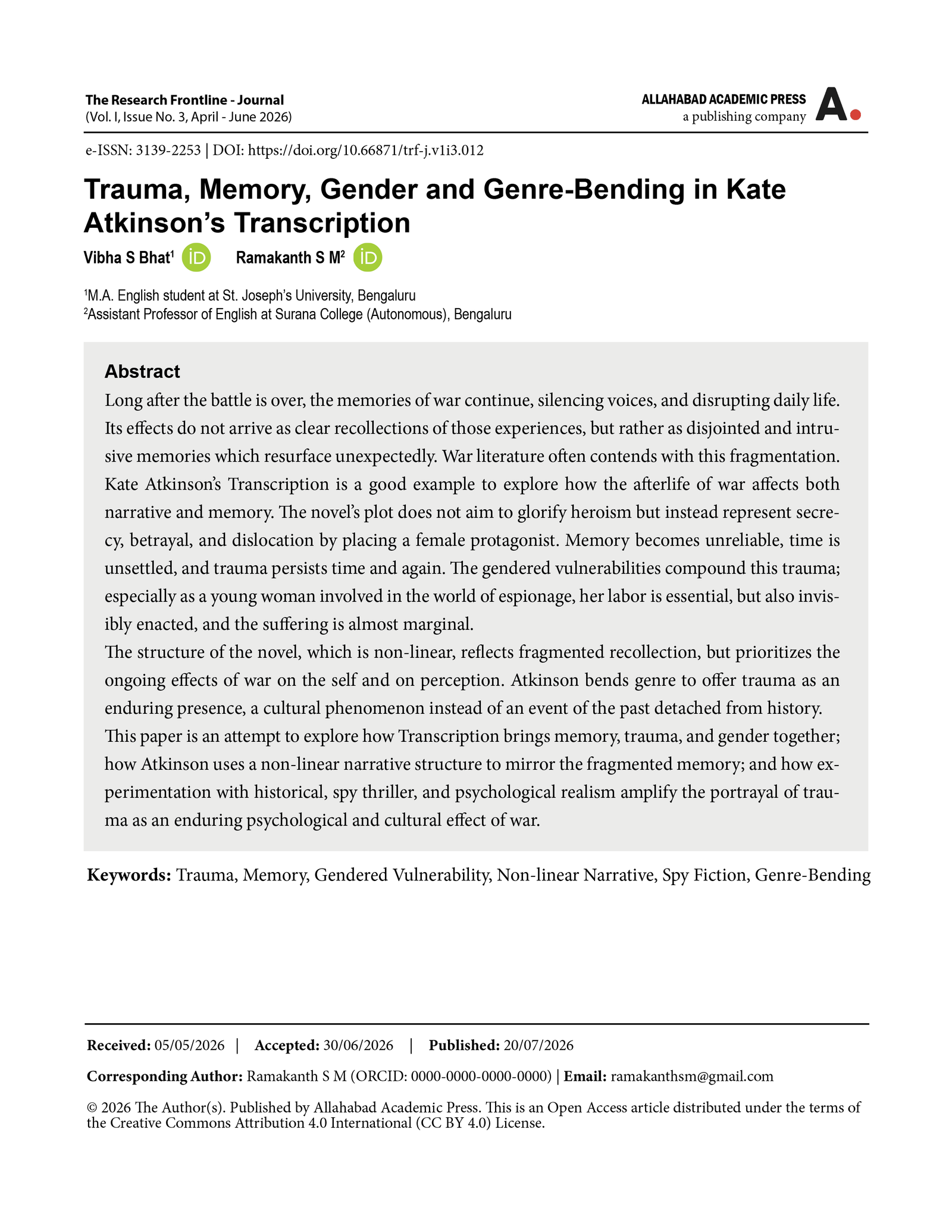
Long after the battle is over, the memories of war continue, silencing voices, and disrupting daily life. Its effects do not arrive as clear recollections of those experiences, but rather as disjointed and intrusive memories which resurface unexpectedly. War literature often contends with this fragmentation.
Kate Atkinson's Transcription is a good example to explore how the afterlife of war affects both narrative and memory. The novel's plot does not aim to glorify heroism but instead represent secrecy, betrayal, and dislocation by placing a female protagonist. Memory becomes unreliable, time is unsettled, and trauma persists time and again. The gendered vulnerabilities compound this trauma; especially as a young woman involved in the world of espionage, her labor is essential, but also invisibly enacted, and the suffering is almost marginal.
The structure of the novel, which is non-linear, reflects fragmented recollection, but prioritizes the ongoing effects of war on the self and on perception. Atkinson bends genre to offer trauma as an enduring presence, a cultural phenomenon instead of an event of the past detached from history.
This paper is an attempt to explore how Transcription brings memory, trauma, and gender together; how Atkinson uses a non-linear narrative structure to mirror the fragmented memory; and how experimentation with historical, spy thriller, and psychological realism amplify the portrayal of trauma as an enduring psychological and cultural effect of war.
References
Atkinson, Kate. Transcription. London: Faber & Faber, 2018.
Bellamy, Matthew A. Spy Fiction and the Making of the Modern Intelligence Agency. 2020. University of Michigan, PhD dissertation. Deep Blue, https://deepblue.lib.umich.edu/bitstream/handle/2027.42/145820/matbel_1.pdf?sequence=1.
Caruth, Cathy. “Unclaimed Experience: Trauma and the Possibility of History.” Yale French Studies, no. 79, 1991, pp. 181–92. JSTOR, https://doi.org/10.2307/2930251. Accessed 20 Sept. 2025.
Crim, Brian E. “John le Carré is Mr. Angry Now that Smiley’s Day Has Gone: Spy Fiction and the Age of Anger.” 2023. Academia.edu, https://www.academia.edu/95759976/_John_le_Carré_is_Mr_Angry_now_that_Smiley_s_day_has_gone_Spy_Fiction_and_the_Age_of_Anger.
David A. T. Stafford. “Spies and Gentlemen: The Birth of the British Spy Novel, 1893-1914.” Victorian Studies, vol. 24, no. 4, 1981, pp. 489–509. JSTOR, http://www.jstor.org/stable/3827226. Accessed 20 Sept. 2025.
Dylan, Huw, and Alan Burton. “An Anarchy of Treason: Public History, Insider Knowledge and the Early Novels of John le Carré.” 2023. Taylor & Francis Online, https://www.tandfonline.com/doi/full/10.1080/02684527.2023.2225934
Erll, Astrid. “Literature, Film, and the Mediality of Cultural Memory.” Media and Cultural Memory, 389.
Hoag, Rachel Lynn. “Looking Inward, Looking Back: John le Carré and the Spy Narrative after the Cold War.” 2023. West Virginia University Research Repository, https://researchrepository.wvu.edu/cgi/viewcontent.cgi?article=12749&context=etd&utm
Morrison, Jago, and Alan Burton. Secrets, Leaks and the Novel: Writers, British Intelligence and the Public Sphere after World War Two. 2023.
O’Sullivan, Paul. “Spy Fiction: Then and Now.” New Zealand International Review, vol. 35, no. 5, 2010, pp. 20–23. JSTOR, http://www.jstor.org/stable/45236076. Accessed 20 Sept. 2025.
Showalter, Elaine. “Toward a Feminist Poetics.” Women Writing and Writing About Women, edited by Mary Jacobus, Croom Helm, 1979, pp. 22–41. Historia Cultural, https://historiacultural.mpbnet.com.br/feminismo/Toward_a_Feminist_Poetics.htm. Accessed 20 Sept. 2025.
Tarvainen, Pinja. Kate Atkinson's Transcription: Rewriting Women in War and Spy Narratives. MA thesis, University of Eastern Finland, 2024.
Wiant, Jon A. “SPY FICTION, SPY REALITY.” American Intelligence Journal, vol. 22, 2004, pp. 21–29. JSTOR, http://www.jstor.org/stable/44327022. Accessed 20 Sept. 2025.
Downloads
Published
Issue
Section
License
Copyright (c) 2026 The Research Frontline - Journal

This work is licensed under a Creative Commons Attribution 4.0 International License.