Income Inequality and Life Satisfaction: A Comparative Study of India and Sweden
DOI:
https://doi.org/10.66871/trf-j.v1i3.010Keywords:
Income Inequality, Life Satisfaction, Well-being, Welfare State, Redistributive Institutions, Capabilities ApproachAbstract
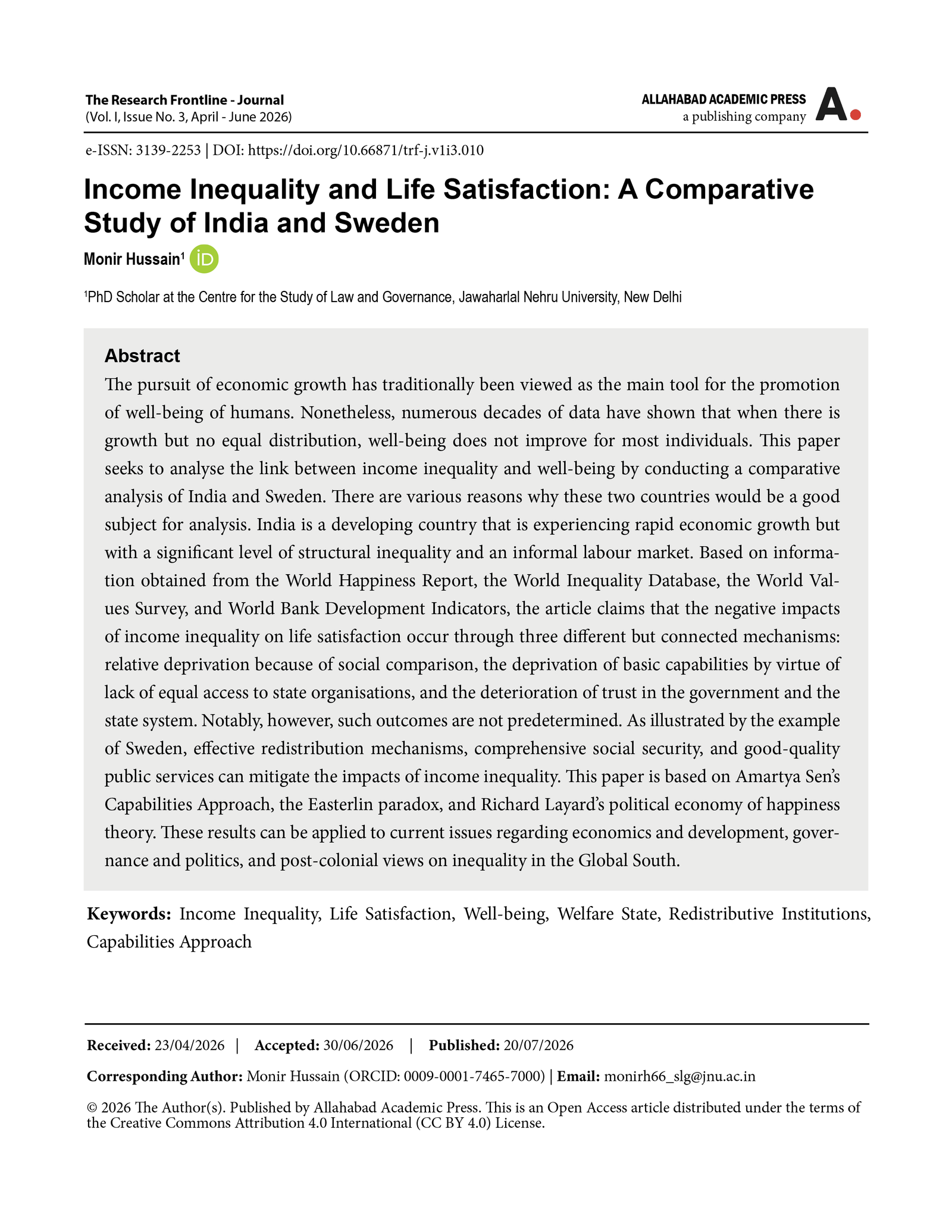
The pursuit of economic growth has traditionally been viewed as the main tool for the promotion of well-being of humans. Nonetheless, numerous decades of data have shown that when there is growth but no equal distribution, well-being does not improve for most individuals. This paper seeks to analyse the link between income inequality and well-being by conducting a comparative analysis of India and Sweden. There are various reasons why these two countries would be a good subject for analysis. India is a developing country that is experiencing rapid economic growth but with a significant level of structural inequality and an informal labour market. Based on information obtained from the World Happiness Report, the World Inequality Database, the World Values Survey, and World Bank Development Indicators, the article claims that the negative impacts of income inequality on life satisfaction occur through three different but connected mechanisms: relative deprivation because of social comparison, the deprivation of basic capabilities by virtue of lack of equal access to state organisations, and the deterioration of trust in the government and the state system. Notably, however, such outcomes are not predetermined. As illustrated by the example of Sweden, effective redistribution mechanisms, comprehensive social security, and good-quality public services can mitigate the impacts of income inequality. This paper is based on Amartya Sen's Capabilities Approach, the Easterlin paradox, and Richard Layard's political economy of happiness theory. These results can be applied to current issues regarding economics and development, governance and politics, and post-colonial views on inequality in the Global South.
References
• Bardhan, Pranab. Awakening Giants, Feet of Clay: Assessing the Economic Rise of China and India. Princeton University Press, 2010.
• Clark, Andrew E., Sarah Fleche, Richard Layard, Nattavudh Powdthavee, and George Ward. The Origins of Happiness: The Science of Well-Being over the Life Course. Princeton University Press, 2018.
• Dreze, Jean, and Amartya Sen. An Uncertain Glory: India and its Contradictions. Allen Lane, 2013.
• Easterlin, Richard A. "Will Raising the Incomes of All Increase the Happiness of All?" Journal of Economic Behavior and Organization, vol. 27, no. 1, 1995, pp. 35-47.
• Esping-Andersen, Gosta. The Three Worlds of Welfare Capitalism. Princeton University Press, 1990.
• George, Alexander L., and Andrew Bennett. Case Studies and Theory Development in the Social Sciences. MIT Press, 2005.
• Helliwell, John F., Richard Layard, Jeffrey D. Sachs, Jan-Emmanuel De Neve, Lara B. Aknin, and Shun Wang, editors. World Happiness Report 2023. Sustainable Development Solutions Network, 2023.
• International Labour Organization. Women and Men in the Informal Economy: A Statistical Picture. 3rd ed., ILO, 2018.
• Korpi, Walter, and Joakim Palme. "The Paradox of Redistribution and Strategies of Equality: Welfare State Institutions, Inequality and Poverty in the Western Countries." American Sociological Review, vol. 63, no. 5, 1998, pp. 661-687.
• Layard, Richard. Happiness: Lessons from a New Science. Penguin Press, 2005.
• Organisation for Economic Co-operation and Development. "Income Inequality (Indicator)." OECD Data, 2024, https://data.oecd.org.
• Rawls, John. A Theory of Justice. Harvard University Press, 1971.
• Rothstein, Bo, and Eric M. Uslaner. "All for All: Equality, Corruption, and Social Trust." World Politics, vol. 58, no. 1, 2005, pp. 41-72.
• Sen, Amartya. Development as Freedom. Oxford University Press, 1999.
• Wilkinson, Richard, and Kate Pickett. The Spirit Level: Why More Equal Societies Almost Always Do Better. Allen Lane, 2009.
• World Bank. World Development Indicators 2024. World Bank, 2024, https://databank.worldbank.org.
• World Inequality Database. "Income Inequality Data for India, 2022." WID, 2022, https://wid.world.
• World Values Survey Association. World Values Survey: Wave 7 (2017-2022). WVSA, 2022, https://www.worldvaluessurvey.org.
Downloads
Published
Issue
Section
License
Copyright (c) 2026 The Research Frontline - Journal

This work is licensed under a Creative Commons Attribution 4.0 International License.