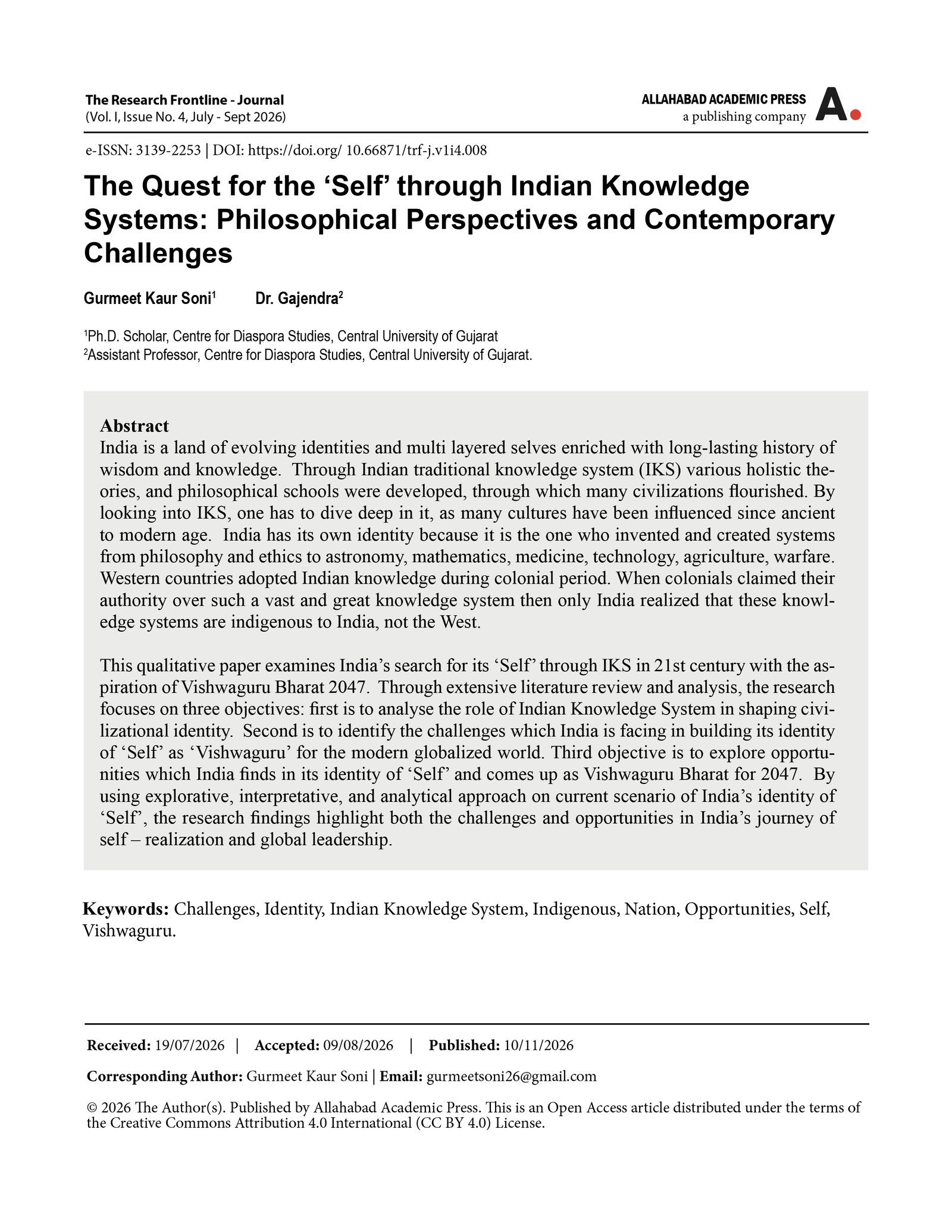
The Quest for the 'Self' through Indian Knowledge Systems: Philosophical Perspectives and Contemporary Challenges
##semicolon##
https://doi.org/10.66871/trf-j.v1i4.008##semicolon##
Challenges##common.commaListSeparator## Identity##common.commaListSeparator## Indian Knowledge System##common.commaListSeparator## Indigenous##common.commaListSeparator## Nation##common.commaListSeparator## Self##common.commaListSeparator## Vishwaguru##common.commaListSeparator## Opportunities##article.abstract##
The renewed scholarly interest in memory, nostalgia, and home in postcolonial literature offers a critical space to examine the enduring legacies of colonialism, racial oppression, and institutional violence in independent nation-states. Literary narratives recover marginalized histories and reveal how social, political, economic, and cultural structures shaped by governance and public policy perpetuate exclusion, displacement, and injustice. This paper comparatively examines Toni Morrison’s Beloved and Alice Walker’s The Color Purple to explore how gender and identity are problematized through Black women’s “triple oppression.” It argues that memory functions as a site of suffering, nostalgia as a means of reclaiming identity, and home as a paradoxical space haunted by violence and loss. Both novels foreground the interconnection of racial discrimination, gendered violence, and economic marginalization, exposing oppressive legal, political, and social institutions that have denied African Americans dignity, justice, and agency. Drawing on postcolonial theory, memory studies, trauma theory, and Black feminist criticism, the paper demonstrates that memory, trauma, and the search for home become political acts of resistance, identity reclamation, communal healing, and historical accountability.
##submission.citations##
Agarwal, Alka. 2025. “Bhartiya Gyan Parampara: An ultimate truth.” In Revitalizing Minds: Navigating the National Education Policy – 2020 and Rediscovering India’s Knowledge System, edited by Prof. Manjula Jain, Dr. Neha Anand, and Dr. Irshad Ahmad Itoo, pp. 61-69. Book Rivers. https://www.researchgate.net/publication/387750246_Bhartya_Gyan_Parampara_An_Ultimate_Truth.
Asher., Mukul. 2024. “Challenges in Progressing Towards Viksit Bharat in Amrit Kaal.” Presentation prepared for International Conference on Prosperous Bharat: A Journey to the third Largest Economy, Shaheed Bhagat Singh Evening College, University of Delhi, February 24, 2024. https://www.ris.org.in/sites/default/files/Opinions-Comments/Challenges%20in%20Progressing%20Towards%20Viksit%20Bharat%20in%20Amrit%20Kaal%20Uni%20of%20Delhi%2022%20Feb%202024%20Mukul%20asher_0.pdf.
Constitution of India. 1950. “Article 1 - India, that is Bharat, shall be a Union of States”.
Dept. of Economic Affairs, Government of India. 2024. The Indian Economy- A review (2024).
Flint, Colin. 2016. Introduction to Geopolitics. 3rd edition. London: Routledge.
Forbes, Magazine, Report July 1987.
Gandhi, Mahatma. 1921. “Young India.” Magzine.
Hosle, Vittorio. 2020. “Nation, State, Nation-State. An Overview.” In Nation, State, Nation – State. Edited by Vitorio Hosle, Marcelo Sanchez Sorondo, and Stefano Zamangi. The Pontifical Academy of Social Sciences. The Proceedings of the 22nd Plenary Session 1-3 May 2019. Libreria Editrice Vaticana. pp. 28-57. ISBN 978-88-86726-34-4. https://www.pass.va/content/dam/casinapioiv/pass/pdf-volumi/acta/acta22pass.pdf.
Jaishankar, S. 2024. India Positioning Itself as Vishwamitra. The Indian Express 2024.
Jaishankar, S. 2024. Why Bharat Matters. Rupa Publications India Pvt. Ltd., ISBN: 9789357027601
Kak, Subhash. 2016. The Astronomical Code of Rigveda. Edition 3rd. Aditya Prakashan. ISBN: 817742159X
Kamble, Dr. Ramesh. 2026. “Self-Reliant India and Integral Humanism: An Ideological Framework of Deendayal Upadhyaya.” International Journal for Multidisciplinary Research. 8 (01): 1 – 8. January-February 2026, E-ISSN: 2582-2160.
Kapoor, Kapil. 2021. “Indian Knowledge Systems: Nature, Philosophy and Character”. In Indian Knowledge Systems, edited by Kapil Kapoor and Avadhesh Kumar Singh. Indian Institute of Advanced Study, Shimla. D.K. Printworld (P) Ltd. pp. 11-32. https://acc.ac.in/wp-content/uploads/2024/04/Indian_Knowledge_Systems-Kapil-Kapoor.pdf.
Khan, Nazneen. Mishra, Manish. and Soni, Rashmi. 2025. “Reviving Indian Knowledge Systems in Higher Education.” ShodhVarta. 04 (6). ISSN 2583 – 8938. https://shodhvarta.in/index.php/SVJ/article/view/PID-251207.
Mamgain, Rohit. 2025. “Implementing NEP 2020 recommendations: Promoting the Indian knowledge system”. Integrated Journal for Research in Arts and Humanities. 5 (3): 135 - 140. https://doi.org/10.55544/ijrah.5.3.15.
Majeed, Tahir. 2025. “India 2047: Marching Towards a Self-Reliant Future.” Dr. Syama Prasad Mookerjee Research Foundation. Effective May 12, 2025. https://spmrf.org/india-2047-marching-towards-a-self-reliant-future/.
Malhotra, Rajiv. 2016. “The Battle for Sanskrit.” Harper Collins Publishers India.
Malhotra, Rajiv. 2011. “Being Different: An Indian Challenge to Western Universalism”. Harper Collins Publishers India.
Mishra, Harshvardhan. 2025. “Viksit Bharat @ 2047: Vision, Challenges, and Roadmap to a Developed India”. Bharat Articles. Effective February 8. Viksit Bharat @ 2047: Vision, Challenges, and Roadmap to a Developed India - Bharat Articles.
Modi, Narendra. 2020. Address to the United Nations General Assembly (UNGA) in September 26.
NextIAS. 2024. “Idea of “Viksit Bharat”. Next IAS, Editorial Analysis. Effective February 10. Idea of “Viksit Bharat 2047”: Notion, Goals, Challenges & More.
Parekh, Bhiku. 2006. “Redefining India’s Identity”. India International Centre Quarterly, 33, (01) (summer 2006): 1-15. https://www.jstor.org/stable/23005931.
Parmar, Giribala. Lallubhai. 2021. “A Study on Challenges and Implications of Self – Reliant India”. International Journal of Early Childhood Special Education (INT-JECSE). 13 (02): 2415 - 2423. ISSN: 1308-5581. DOI: 10.48047/intjecse/V13i2.211271
Press Information Bureau. 2024.“Empowering Youth for a Developed India: Viksit Bharat Young Leaders Dialogue.” Effective November 21. Government of India. https://static.pib.gov.in/WriteReadData/specificdocs/documents/2024/nov/doc20241121439501.pdf
Rajput, P. S., Chari, Sharabu. N., Singh, Ruchi., and Joshi, Kaveri. 2025. “Role of Indian Knowledge System in NEP 2020: A Comparative Study.” International Journal of Information, Library and Society 14 (2): 38 - 43.
Rose, Vanita. & Kadian, Romi. 2024. “Exploring the Scientific Principle of Ancient Indian Education: Revisiting Bhartiya Gyan Parampara.” International Journal of Development Research, 14 (12): 67134 - 67137, December, 2024.
Singh, Karan. A., and Tewari, Anirudh. 2026. “Viksit Bharat 2047: The role of AI in India’s growth strategy.” The Week. Effective April 09, 2026.
https://www.theweek.in/news/sci-tech/2026/04/09/viksit-bharat-2047-the-role-of-ai-in-indias-growth-strategy.html Viksit Bharat 2047: The role of AI in India’s growth strategy- The Week
ViksitIndia. Bold Vision Ahead: Empowering India through holistic development for a brighter, inclusive future by 2047. Viksit India: Vision for a Developed Nation by 2047 | Viksit India. Accessed on February 21, 2026.
Wikipedia. Bhartiya Knowledge Systems and Traditions. Accessed on September 15, 2025.
Yadav, Sakshi. and Agrahari, Rajnish. 2025. “Role of Technology for Promotion of Indian Knowledge System.” The Journal of Scientific Discourse. 2 (3): 146-157. ISSN: 3049-0081.
##submission.downloads##
##submissions.published##
##issue.issue##
##section.section##
##submission.license##
##submission.copyrightStatement##
##submission.license.cc.by4.footer##