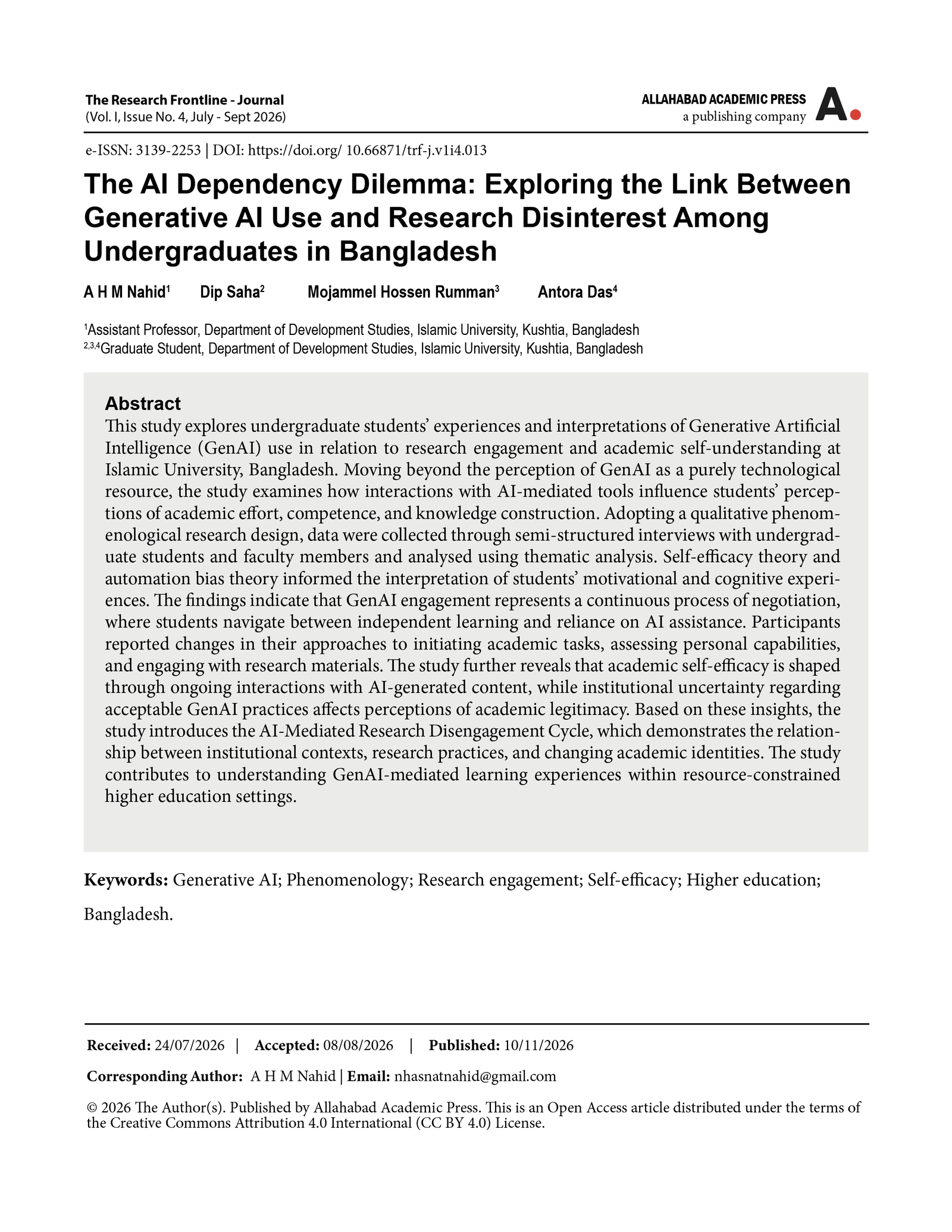
The AI Dependency Dilemma: Exploring the Link Between Generative AI Use and Research Disinterest Among Undergraduates in Bangladesh
##semicolon##
https://doi.org/10.66871/trf-j.v1i4.013##semicolon##
Generative AI##common.commaListSeparator## Phenomenology##common.commaListSeparator## Research Engagement##common.commaListSeparator## Self-efficacy##common.commaListSeparator## Higher Education##common.commaListSeparator## Bangladesh##article.abstract##
This study explores undergraduate students’ experiences and interpretations of Generative Artificial Intelligence (GenAI) use in relation to research engagement and academic self-understanding at Islamic University, Bangladesh. Moving beyond the perception of GenAI as a purely technological resource, the study examines how interactions with AI-mediated tools influence students’ perceptions of academic effort, competence, and knowledge construction. Adopting a qualitative phenomenological research design, data were collected through semi-structured interviews with undergraduate students and faculty members and analysed using thematic analysis. Self-efficacy theory and automation bias theory informed the interpretation of students’ motivational and cognitive experiences. The findings indicate that GenAI engagement represents a continuous process of negotiation, where students navigate between independent learning and reliance on AI assistance. Participants reported changes in their approaches to initiating academic tasks, assessing personal capabilities, and engaging with research materials. The study further reveals that academic self-efficacy is shaped through ongoing interactions with AI-generated content, while institutional uncertainty regarding acceptable GenAI practices affects perceptions of academic legitimacy. Based on these insights, the study introduces the AI-Mediated Research Disengagement Cycle, which demonstrates the relationship between institutional contexts, research practices, and changing academic identities. The study contributes to understanding GenAI-mediated learning experiences within resource-constrained higher education settings.
##submission.citations##
Abbas, Z., J. Zhang, and M. Junaid. 2026. “When Learning Meets the Machine: How AI-Assisted Tools Reshape Deep and Surface Learning in Higher Education.” Computers in Human Behaviour Reports 22: 101057. https://doi.org/10.1016/j.chbr.2026.101057.
Akter, N., M. N. I. Nepo, M. S. Chowdhury, M. S. Sadique, M. E. Haque, T. Bhuiyan, and M. Hasan. 2026. “Responsible AI Integration in Higher Education: Drivers and Effects in the Context of Bangladesh.” International Journal of Information and Learning Technology 43 (3): 275–300. https://doi.org/10.1108/IJILT-09-2025-0268.
Bandura, A. 1997. Self-Efficacy: The Exercise of Control. New York: Freeman.
Braun, V., and V. Clarke. 2006. “Using Thematic Analysis in Psychology.” Qualitative Research in Psychology 3 (2): 77–101. https://doi.org/10.1191/1478088706qp063oa.
Creswell, J. W., and C. N. Poth. 2018. Qualitative Inquiry and Research Design: Choosing Among Five Approaches. 4th ed. Thousand Oaks, CA: Sage.
Das, Apu Chandra, Debabrata Das, Badhon Roy, and Shipra Barman. 2026. “Residential Environment and Academic Performance in Bangladeshi Public Universities.” Discover Education 5 (1). https://doi.org/10.1007/s44217-026-02027-2.
Denzin, N. K., and Y. S. Lincoln. 2018. The SAGE Handbook of Qualitative Research. 5th ed. Thousand Oaks, CA: Sage.
Dwivedi, Y. K., et al. 2023. “So What If ChatGPT Wrote It? Multidisciplinary Perspectives on Opportunities, Challenges and Implications of Generative Conversational AI for Research, Practice and Policy.” International Journal of Information Management 71: 102642. https://doi.org/10.1016/j.ijinfomgt.2023.102642.
Hasib, M., and M. S. Islam. 2025. “How University Students in Bangladesh Engage with ChatGPT: A Qualitative Study.” PLOS ONE 20 (9): e0333089. https://doi.org/10.1371/journal.pone.0333089.
Holmes, W., M. Bialik, and C. Fadel. 2019. Artificial Intelligence in Education: Promises and Implications for Teaching and Learning. Boston: Center for Curriculum Redesign.
Hou, Yating, Linhui Hu, Shaojun Qiu, Zhichao Yan, Mingyu Zhou, Feiling Zheng, Zeyi Li, Xing Ke, and Yisheng Huang. 2025. “Perceptions, Attitudes, and Barriers to Research Engagement Among General Medicine Undergraduates in a Tertiary Hospital in Guangdong, China.” BMC Medical Education 25 (1): 773. https://doi.org/10.1186/s12909-025-07343-z.
Howard, J. L., J. S. Bureau, F. Guay, J. X. Y. Chong, and R. M. Ryan. 2021. “Student Motivation and Engagement in Higher Education: The Role of Self-Determination Theory.” Contemporary Educational Psychology 65: 101930. https://doi.org/10.1177/1745691620966789.
Kasneci, E., K. Sessler, S. Küchemann, M. Bannert, D. Dementieva, F. Fischer, U. Gasser, et al. 2023. “ChatGPT for Good? On Opportunities and Challenges of Large Language Models for Education.” Learning and Individual Differences 103: 102274. https://doi.org/10.1016/j.lindif.2023.102274.
Kvale, S., and S. Brinkmann. 2015. InterViews: Learning the Craft of Qualitative Research Interviewing. 3rd ed. Thousand Oaks, CA: Sage.
Lincoln, Y. S., and E. G. Guba. 1985. Naturalistic Inquiry. Thousand Oaks, CA: Sage. https://doi.org/10.1016/0147-1767(85)90062-8.
Lintner, Tomáš, Libor Juhaňák, Markéta Žáková, Lukáš Plch, and Ivan Ropovik. 2026. “Generative AI Use and Academic Achievement: A Cross-Sectional Study of Czech Seventh-Grade Students.” Education and Information Technologies 31 (13): 4829–48. https://doi.org/10.1007/s10639-026-14002-3.
Lu, J., W. Li, Y. Mo, and M. Ge. 2026. “Supportive University Climate and AI Dependence Among Undergraduates: The Sequential Mediating Role of Academic Self-Efficacy and Self-Control.” Behavioural Sciences 16 (6): 902. https://doi.org/10.3390/bs16060902.
Maska, L., D. Kalamaras, and P. Vlachopanou. 2026. “Profiling University Students’ Academic AI Use Through Correspondence Analysis Across Disciplines.” Research Square. https://doi.org/10.21203/rs.3.rs-9515946/v1.
Mitsugi, Naoki, Koki Ijuin, Chiaki Oshiyama, Eri Hara, and Takuichi Nishimura. 2025. “An AI-Mediated Framework for Recursive Learning: Transforming Individual Experiences into Organisational Knowledge and Autonomous Engagement in Elderly Care.” Frontiers in Digital Health 7 (July): 1529072. https://doi.org/10.3389/fdgth.2025.1529072.
Nygren, Åse, Anna Eriksson, Jeanette Sjöberg, and Emil Alégroth. 2026. “Exploring Student Use of Generative AI in Higher Education: A Dual-Institutional Study.” Education and Information Technologies, August. https://doi.org/10.1007/s10639-026-14100-2.
Panagopoulos, E., C. M. Liapis, A. Adamopoulou, I. Kamarianos, and S. Kotsiantis. 2026. “Trust, Education, and Artificial Intelligence: Adoption, Explainability, and Epistemic Authority Among Teacher-Education Undergraduates in Greece.” Algorithms 19 (5): 350. https://doi.org/10.3390/a19050350.
Parasuraman, R., and D. H. Manzey. 2010. “Complacency and Bias in Human Use of Automation: An Attentional Integration.” Human Factors 52 (3): 381–410. https://doi.org/10.1177/0018720810376055.
Patton, M. Q. 2015. Qualitative Research & Evaluation Methods. 4th ed. Thousand Oaks, CA: Sage.
Rahman, Md. Mominur, and Foday Joof. 2026. “Investigating Technology, Language, and Institutional Context: The Moderating Role of Public University Environments Among Bangladeshi Graduates.” Discover Education 5 (1). https://doi.org/10.1007/s44217-026-01507-9.
Rudolph, J., S. Tan, and S. Tan. 2023. “ChatGPT: Bullshit Spewer or the End of Traditional Assessments in Higher Education?” Journal of Applied Learning & Teaching 6 (1). https://doi.org/10.3316/informit.T2025102700003092061569891.
Ryan, R. M., and E. L. Deci. 2020. “Intrinsic and Extrinsic Motivation from a Self-Determination Theory Perspective: Definitions, Theory, Practices, and Future Directions.” Contemporary Educational Psychology 61: 101860. https://doi.org/10.1016/j.cedpsych.2020.101860.
Schunk, D. H. 2012. Learning Theories: An Educational Perspective. 6th ed. Boston: Pearson.
Schunk, D. H., and M. K. DiBenedetto. 2017. “Motivation and Social Cognitive Theory.” Contemporary Educational Psychology 60: 1–12. https://doi.org/10.1016/j.cedpsych.2019.101832.
Schunk, D. H., and F. Pajares. 2002. “The Development of Academic Self-Efficacy.” In Development of Achievement Motivation, edited by A. Wigfield and J. S. Eccles, 15–31. San Diego: Academic Press. https://doi.org/10.1016/B978-012750053-9/50003-6.
Shaw, David. 2025. “The Digital Erosion of Intellectual Integrity: Why Misuse of Generative AI Is Worse Than Plagiarism.” AI & Society 40 (8): 5819–21. https://doi.org/10.1007/s00146-025-02362-2.
Surata, I. K., Sudiadharma, and P. M. Lopulalan. 2026. “Students’ Experiences of Learning Authenticity in Artificial Intelligence-Assisted Academic Work.” Formosa Journal of Science and Technology 5 (3): 715–730. https://doi.org/10.55927/fjst.v5i3.25.
Tisza, Gabriella, Panos Markopoulos, Sofia Serholt, Jauwairia Nasir, Omar Mubin, Adriana Tapus, Salvatore Anzalone, et al. 2025. “Generative AI-powered Social Robots in Education: Opportunities and Challenges From a Delphi Study.” Behaviour and Information Technology 45 (12): 2975–97. https://doi.org/10.1080/0144929x.2025.2604060.
UNESCO. 2023. Guidance for Generative AI in Education and Research. Paris: UNESCO Publishing. https://www.unesco.org/en/articles/guidance-generative-ai-education-and-research.
Weerakoon, Chamindika, Rosemary Fisher, Thi Thanh Quyen Tran, Taylor Gogan, and James Williams. 2026. “Recursive Self-Regulation in GenAI-Assisted Experiential Learning: A Task-Contingent Model.” The International Journal of Management Education 25 (1): 101516. https://doi.org/10.1016/j.ijme.2026.101516.
Zawacki-Richter, O., V. I. Marín, M. Bond, and F. Gouverneur. 2019. “Systematic Review of Research on Artificial Intelligence Applications in Higher Education: Where Are the Educators?” International Journal of Educational Technology in Higher Education 16: 39. https://doi.org/10.1186/s41239-019-0171-0.
##submission.downloads##
##submissions.published##
##issue.issue##
##section.section##
##submission.license##
##submission.copyrightStatement##
##submission.license.cc.by4.footer##