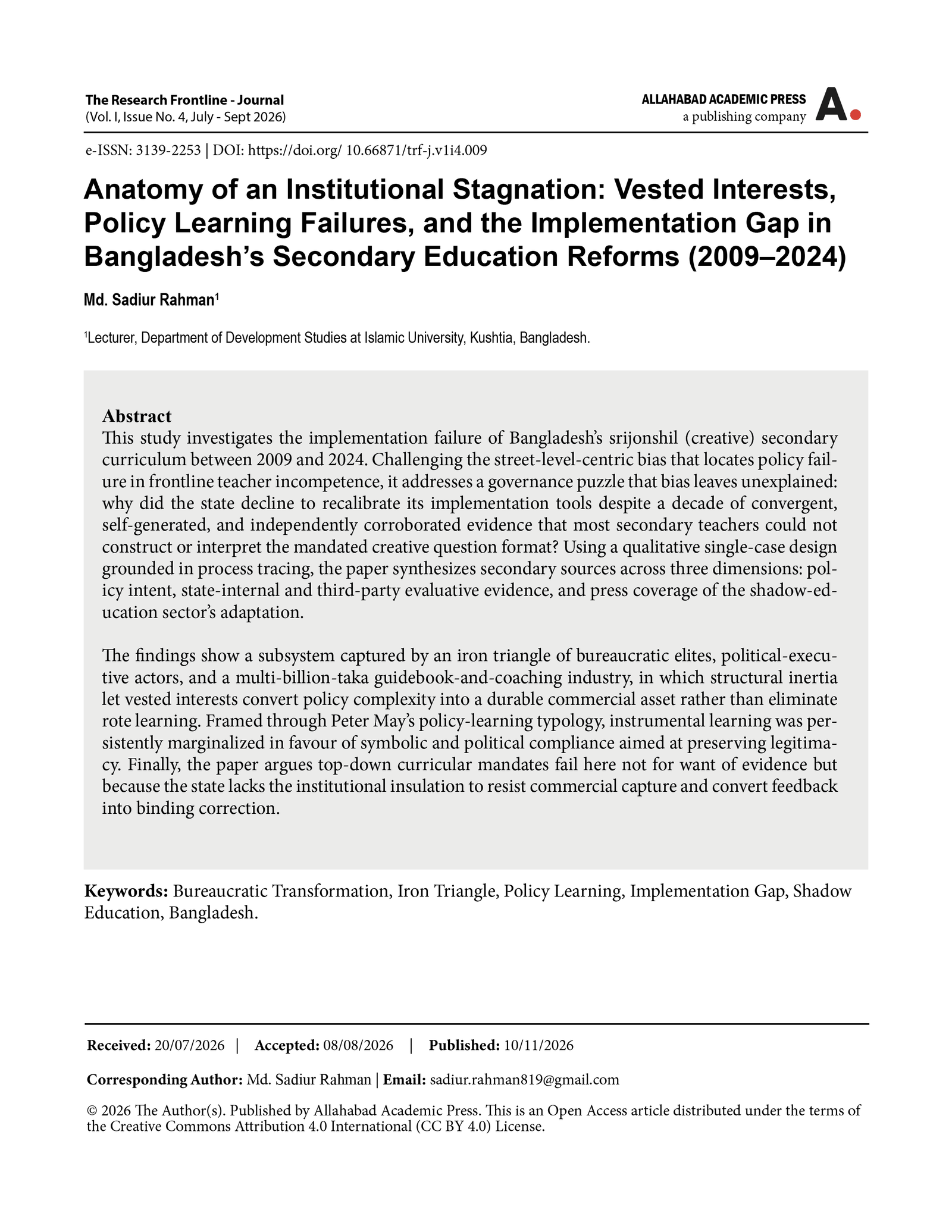
Anatomy of an Institutional Stagnation: Vested Interests, Policy Learning Failures, and the Implementation Gap in Bangladesh’s Secondary Education Reforms (2009–2024)
##semicolon##
https://doi.org/10.66871/trf-j.v1i4.009##semicolon##
Bureaucratic Transformation##common.commaListSeparator## Iron Triangle##common.commaListSeparator## Policy Learning##common.commaListSeparator## Implementation Gap##common.commaListSeparator## Shadow Education##common.commaListSeparator## Bangladesh##article.abstract##
This study investigates the implementation failure of Bangladesh’s srijonshil (creative) secondary curriculum between 2009 and 2024. Challenging the street-level-centric bias that locates policy failure in frontline teacher incompetence, it addresses a governance puzzle that bias leaves unexplained: why did the state decline to recalibrate its implementation tools despite a decade of convergent, self-generated, and independently corroborated evidence that most secondary teachers could not construct or interpret the mandated creative question format? Using a qualitative single-case design grounded in process tracing, the paper synthesizes secondary sources across three dimensions: policy intent, state-internal and third-party evaluative evidence, and press coverage of the shadow-education sector’s adaptation. The findings show a subsystem captured by an iron triangle of bureaucratic elites, political-executive actors, and a multi-billion-taka guidebook-and-coaching industry, in which structural inertia let vested interests convert policy complexity into a durable commercial asset rather than eliminate rote learning. Framed through Peter May’s policy-learning typology, instrumental learning was persistently marginalized in favour of symbolic and political compliance aimed at preserving legitimacy. Finally, the paper argues top-down curricular mandates fail here not for want of evidence but because the state lacks the institutional insulation to resist commercial capture and convert feedback into binding correction.
##submission.citations##
Adams, Gordon. 1981. The Politics of Defense Contracting: The Iron Triangle (ISBN 9780878710126). New York: Council on Economic Priorities.
Albert.io. 2019. “Iron Triangle: AP® US Government Crash Course.” Albert Blog & Resources. December 2019. https://www.albert.io/blog/iron-triangle-ap-us-government-crash-course/.
Alamgir, Mohiuddin, and Dipan Nandy. 2022. "Creative Question Paper: Over One in 3 Bangladesh Teachers Out of Their Depth." Asia News Network, November 10, 2022. https://asianews.network/creative-question-paper-over-one-in-3-bangladesh-teachers-out-of-their-depth/.
Azim, F. 2018. “An Analysis of the Secondary School Certificate Examination: The Case of Creative Questions.” In Engaging in Educational Research: Revisiting Policy and Practice in Bangladesh, edited by R. Chowdhury, M. Sarkar, F. Mojumder, and M. M. Roshid, 221–238. Singapore: Springer. https://doi.org/10.1007/978-981-13-0708-9.
Billah, Masum. 2012. “Creative System Has Created a Quagmire | Bangladesh Education Article.” Bangladesh Education Article. November 7, 2012. https://bdeduarticle.com/creative-system-has-created-a-quagmire/.
Billah, Masum. 2025. “Why Has the Coaching Revolution Occurred in the Country? | Bangladesh Education Article.” Bangladesh Education Article. December 11, 2025. https://bdeduarticle.com/coaching/.
Bloom, Benjamin Samuel. 1956. Taxonomy of Educational Objectives The Classification of Educational Goals (ISBN 0679302093). D. McKay.
Bdnews24. 2022. “A New Curriculum Brings Cheers and Challenges to Bangladesh’s Education,” September 15, 2022. https://bdnews24.com/education/osprtvsw8z.
Bonikbarta. 2025. “Secondary Education Quality Declining for over Ten Years.” August 9, 2025. https://en.bonikbarta.com/bangladesh/lge6DWs7gDhFLBXj.
Bray, Mark, and Chad Lykins. 2012. Shadow Education: Private Supplementary Tutoring and Its Implications for Policy Makers in Asia (ISBN 978-92-9092-659-7). Manila: Asian Development Bank; Hong Kong: Comparative Education Research Centre, University of Hong Kong.
CAMPE. 2019. Education Watch 2018–19: Secondary School Teachers in Bangladesh in the Light of SDG 4. Dhaka: CAMPE. Retrieved from https://campebd.org/education-watch/education-watch-report-full-version/
CAMPE. 2022. Education Watch 2022: Post-Pandemic Education Recovery and Renewal of School Education. Dhaka: CAMPE. Retrieved from https://campebd.org/education-watch/education-watch-report-full-version/
CAMPE. 2023. Education Watch 2023: School Education in Bangladesh — Post-Pandemic Resilience and Sustainability. Dhaka: CAMPE. Retrieved from https://campebd.org/education-watch/education-watch-report-full-version/
Daily Sun. 2026. “Coaching Centres Boom as Admission Race Intensifies.” April 19, 2026. https://www.daily-sun.com/back-page/869000.
Dhaka Tribune. 2018. “29% of Education Cost Goes to Coaching, Private Tutor”. January 26, 2018. https://www.dhakatribune.com/bangladesh/bangladesh-others/136525/29%25-of-education-cost-goes-to-coaching-private.
Dunlop, Claire A., and Claudio M. Radaelli. 2013. “Systematising Policy Learning: From Monolith to Dimensions.” Political Studies 61 (3): 599–619. https://doi.org/10.1111/j.1467-9248.2012.00982.x
Financial Express. 2025. “Booming Business of Coaching Centres.” October 10, 2025. https://thefinancialexpress.com.bd/views/opinions/booming-business-of-coaching-centres.
Future Startup. 2023. “Market-Map: The State of Edtech in Bangladesh.” March 27, 2023. https://futurestartup.com/2023/03/27/the-state-edtech-in-bangladesh/.
Habib, Wasim Bin. 2016. “Creative Method Still Ineffective.” The Daily Star, March 1, 2016. https://www.thedailystar.net/backpage/creative-method-still-ineffective-784417.
Hall, Peter A. 1993. “Policy Paradigms, Social Learning, and the State: The Case of Economic Policymaking in Britain.” Comparative Politics 25 (3): 275–296. https://doi.org/10.2307/422246
Hickey, Sam, and Naomi Hossain, eds. 2019. The Politics of Education in Developing Countries: From Schooling to Learning. Oxford: Oxford University Press. https://doi.org/10.1093/oso/9780198835684.001.0001
Hossain, Naomi, Mirza M. Hassan, Muhammad Ashikur Rahman, Khondoker Shakhawat Ali, and Md. Sajidul Islam. 2019. “The Politics of Learning Reforms in Bangladesh.” In The Politics of Education in Developing Countries: From Schooling to Learning, edited by Sam Hickey and Naomi Hossain, 64–85. Oxford: Oxford University Press. https://doi.org/10.1093/oso/9780198835684.003.0004
Hossan, Md. Alomgir, and Md. Burhan Uddin Milon. 2025. “Policy and Practice in Bangladesh: Obstacles and Outcomes.” DIROSAT: Journal of Education, Social Sciences & Humanities 3 (4): 492–505. https://doi.org/10.58355/dirosat.v3i4.161
Islam, Shahidul, Arifur Rahman, Uthpal Chandra Paul, and Md. Khaleduzzaman. 2025. “Teachers’ Perceptions of and Adaptations to Implementing a Competency-Based Curriculum at the Secondary Level in Bangladesh.” Oxford Review of Education 52 (3): 366–84. https://doi.org/10.1080/03054985.2025.2470816.
Kabir, Md Ariful Haq. 2016. Micro-Politics of Neoliberal Policy Formulation in the Higher Education Sector in Bangladesh. PhD diss., Monash University. https://doi.org/10.4225/03/58b8ac06b7f07
Lipsky, Michael. 1980. Street-Level Bureaucracy: Dilemmas of the Individual in Public Services. New York: Russell Sage Foundation. http://www.jstor.org/stable/10.7758/9781610447713.
Mahmud, Rafsan, and Husaina Banu Kenayathulla. 2017. “Shadow Education: Patterns and Scale of Private Supplementary Tutoring in English in Secondary Education at Urban Dhaka in Bangladesh.” Compare: A Journal of Comparative and International Education, published online June 29, 2017. https://doi.org/10.1080/03057925.2017.1340827.
Mahmud, Rafsan, and Peter Kwok. 2025. “Shadow Schooling: Realizing Societal Concerns, Seasonal Tutoring and Differences in Rural Bangladesh.” SN Social Sciences 5: 201. https://doi.org/10.1007/s43545-025-01240-4.
Mamun, Harun Ar-Rashid, Sammi Akter Bithy, and Sanzida Khanam. 2023. “Tale of Education Policy in Bangladesh: Development, Changes, and Adaptation Approach.” British Journal of Arts and Humanities 5 (3): 150–65. doi: 10.34104/bjah.0230150016565
Matland, Richard E. 1995. “Synthesizing the Implementation Literature: The Ambiguity-Conflict Model of Policy Implementation.” Journal of Public Administration Research and Theory 5 (2): 145–74. http://www.jstor.org/stable/1181674.
May, Peter J. 1992. “Policy Learning and Policy Failure.” Journal of Public Policy 12 (4): 331–54.doi: https://doi.org/10.1017/S0143814X00005602
McConnell, Grant. 1966. Private Power and American Democracy (ISBN 0394708458). New York: Alfred A. Knopf.
Ministry of Education, Government of the People’s Republic of Bangladesh. 2010. National Education Policy 2010. Dhaka: Ministry of Education. Retrieved from https://reliefweb.int/report/bangladesh/national-education-policy-2010-enbn
Arpa, Anika. (2024). “Curriculum Implementation Scenario in Bangladesh and Role of NCTB.” ResearchGate. https://www.researchgate.net/publication/381029058.
Pressman, Jeffrey L., and Aaron Wildavsky. 1973. Implementation: How Great Expectations in Washington Are Dashed in Oakland (ISBN 0520052331). Berkeley: University of California Press.
Rouf, Md. Abdur. 2021. “Ten Years of the National Education Policy in Bangladesh: Examining the Policy Directions and Implementation Gaps.” Jagannath University Journal of Arts 11 (2): 219–32. Retrieved from https://www.researchgate.net/publication/358638736_Ten_Years_of_the_National_Education_Policy_in_Bangladesh_Examining_the_Policy_Directions_and_Implementation_Gaps
Rumman, Mojammel Hossen, and A. H. M. Nahid. 2026. “Teachers’ Challenges with CBE in Bangladesh: A Phenomenological Study.” The Curriculum Journal. https://doi.org/10.1002/curj.70045.
Shahan, Asif M., and Md. Sadiur Rahman. 2026. “Politics, Evidence and Policy Change: An In-Depth Study of Nutrition Policy Reform (1997–2015) in Bangladesh.” Journal of Governance, Security & Development, 7(2). https://doi.org/10.52823/CWRU3459.
Stigler, George J. 1971. “The Theory of Economic Regulation.” Bell Journal of Economics and Management Science 2 (1): 3–21. https://doi.org/10.2307/3003160
The Daily Star. 2016. “Education Policy—Excellent on Paper.” https://www.thedailystar.net/supplements/25th-anniversary-special-part-3/education-policy-excellent-paper-211432.
theindependentbd.com. 2017. “The Initiative of Creative Questions Has Failed.” December 13, 2017. https://theindependentbd.com/printversion/details/127842.
UNB. 2026. “Bangladesh’s Coaching Centre Policy: 25 Years, Zero Closures.” April 7, 2026. https://unb.com.bd/category/Bangladesh/bangladeshs-coaching-centre-policy-25-years-zero-closures/183090.
World Bank. 2019. Whither Quality? What Do Recent National Assessments of Student Learning Outcomes in Bangladesh Tell Us? Washington, DC: World Bank. Retrieved from https://documents.worldbank.org/pt/publication/documents-reports/documentdetail/489301625254132791.
Yasmin, S., S. Akter, M. R. Islam, M. Rahman, and N. Sultana. 2020. “Creative Education System at Secondary Level in Bangladesh: Teachers’ and Students’ Perspectives.” Journal of Public Administration and Governance 10 (2). https://doi.org/10.5296/jpag.v10i2.17236
##submission.downloads##
##submissions.published##
##issue.issue##
##section.section##
##submission.license##
##submission.copyrightStatement##
##submission.license.cc.by4.footer##