The Tazkira as Palimpsest: Reading Myth, Morality, and Memory in Nur Jahan’s Portrait: Methodological paper on extracting history from layered anecdotes and biases.
DOI:
https://doi.org/10.66871/trf-j.v1i3.015Keywords:
Tazkira, Palimpset, Mughal historiography, Nur Jahan, Gender and Sovereignity, Cultural memory, Indo-Persian Literature, Moral imagination, Archive Theory, Discourse, Discourse analysis, Indian History JournalAbstract
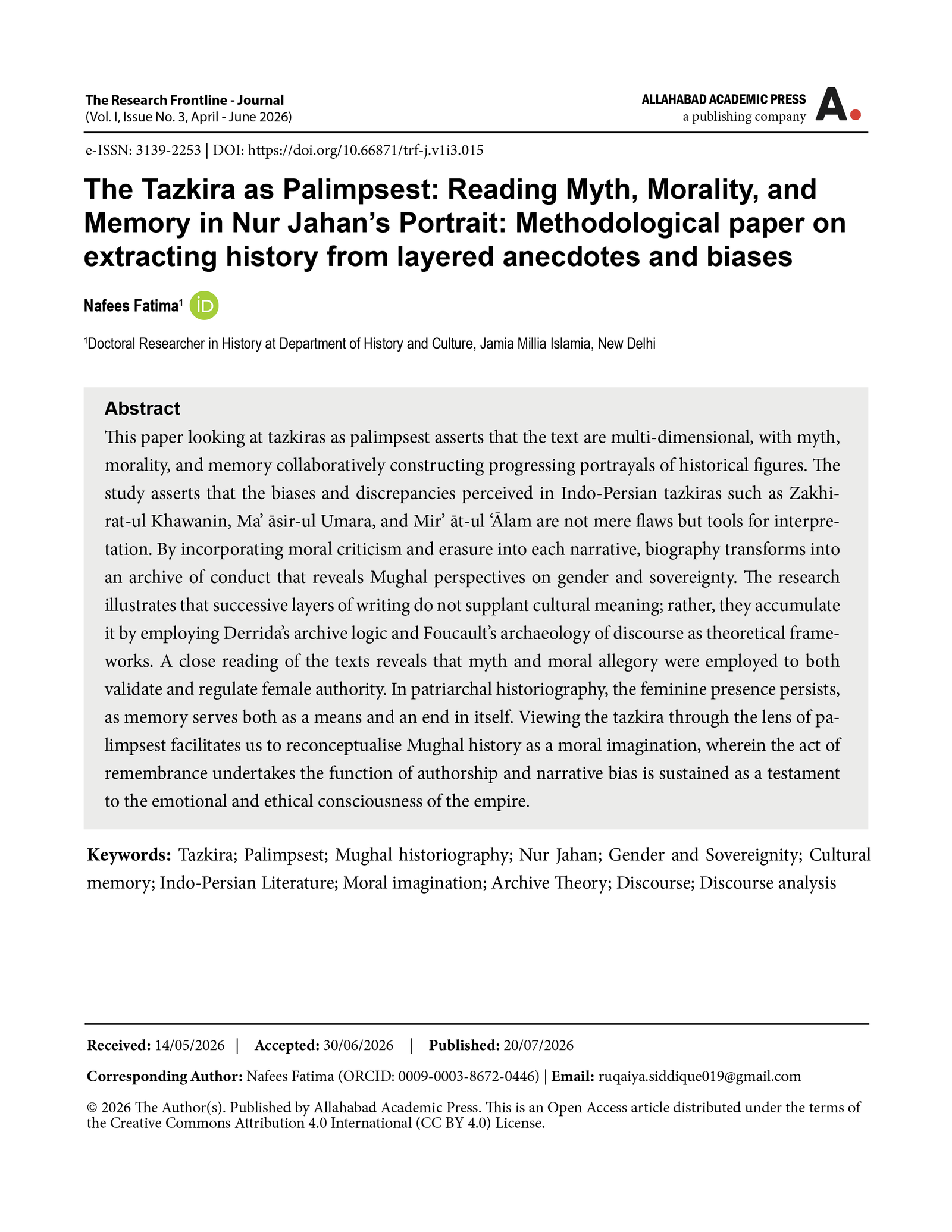
This paper looking at tazkiras as palimpsest asserts that the text are multi-dimensional, with myth, morality, and memory collaboratively constructing progressing portrayals of historical figures. The study asserts that the biases and discrepancies perceived in Indo-Persian tazkiras such as Zakhirat-ul Khawanin, Maʾāsir-ul Umara, and Mirʾāt-ul ʿĀlam are not mere flaws but tools for interpretation. By incorporating moral criticism and erasure into each narrative, biography transforms into an archive of conduct that reveals Mughal perspectives on gender and sovereignty. The research illustrates that successive layers of writing do not supplant cultural meaning; rather, they accumulate it by employing Derrida's archive logic and Foucault's archaeology of discourse as theoretical frameworks. A close reading of the texts reveals that myth and moral allegory were employed to both validate and regulate female authority. In patriarchal historiography, the feminine presence persists, as memory serves both as a means and an end in itself. Viewing the tazkira through the lens of palimpsest facilitates us to reconceptualise Mughal history as a moral imagination, wherein the act of remembrance undertakes the function of authorship and narrative bias is sustained as a testament to the emotional and ethical consciousness of the empire.
References
1. WER
2. XYZ
Downloads
Published
Issue
Section
License
Copyright (c) 2026 The Research Frontline - Journal

This work is licensed under a Creative Commons Attribution 4.0 International License.